Inventory
Track hardware across warehouse locations, technicians, and installed services, with serial numbers, barcode scanning, bulk receiving of up to 50 serials at a time, and a full audit history of every movement.
What It's For
Inventory helps you track physical hardware end-to-end:
- what devices you own (by template/model),
- where they are (warehouse location or with a technician),
- whether they are installed on a customer service,
- and the full movement history (audit trail).
Inventory is part of the Inventory feature on the Growth and Scale plans, and it is gated by the inventory view permission - so warehouse staff can be given stock access without the billing side of the panel.
Key Concepts (How Inventory Is Structured)
| Concept | What it means | Where you use it |
|---|---|---|
| Equipment template | A device "type" you stock (name/model/SKU, serial requirement, notes) | Used when receiving/adding devices |
| Device | A single physical unit (optionally with a serial number) | Listed in Devices tab; managed in device view |
| Location | A storage place (warehouse, vehicle stock, office, etc.) | Used to mark devices "In Stock" somewhere |
| Technician | A person who can hold devices | Used when handing devices to field staff |
| Category | A way to group templates (routers, ONTs, radios, etc.) | Helps filtering and reporting |
Tabs On /inventory
| Tab | Use it for |
|---|---|
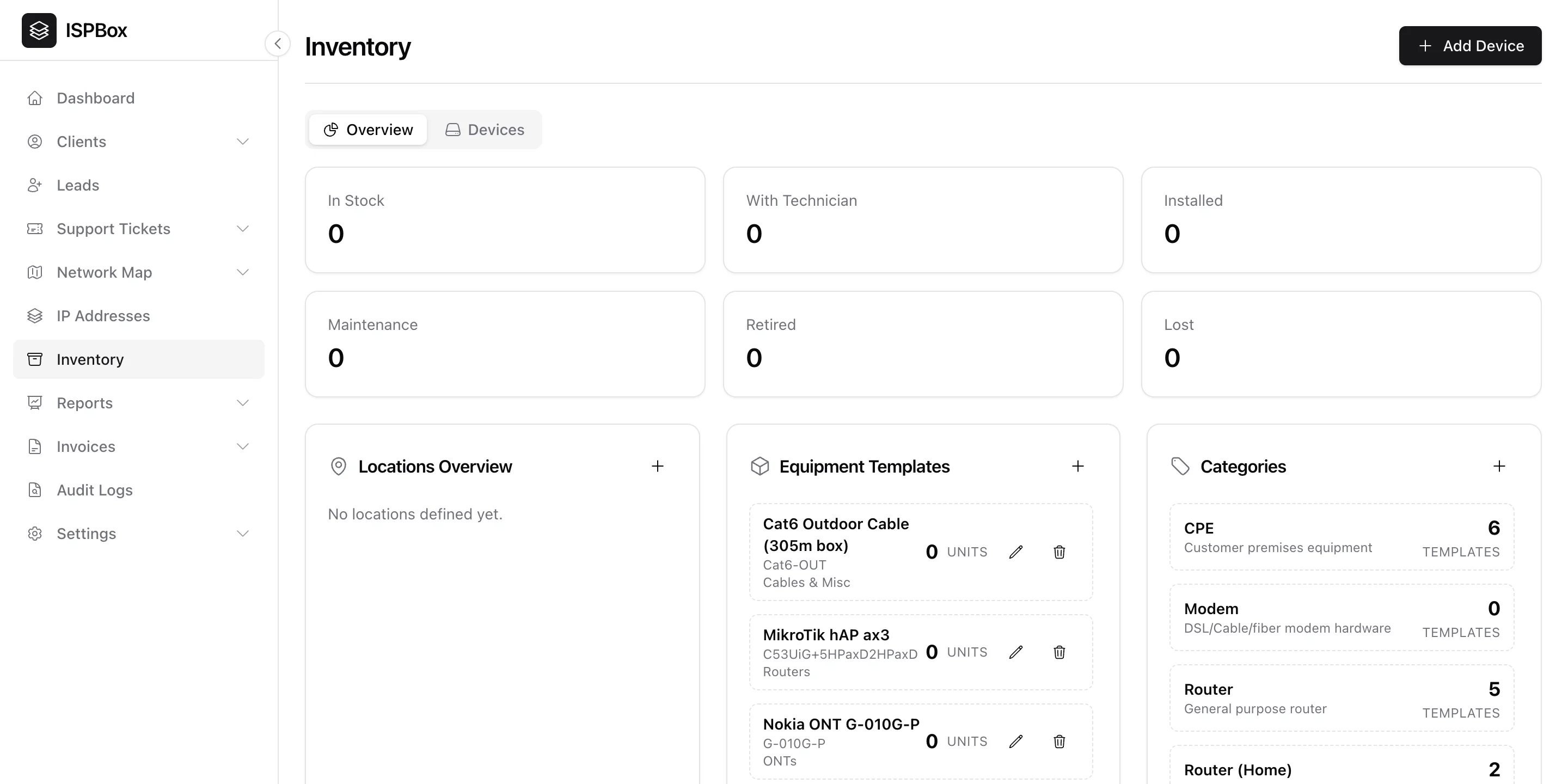
| Overview | Quick totals by status + manage Locations, Templates, Categories |
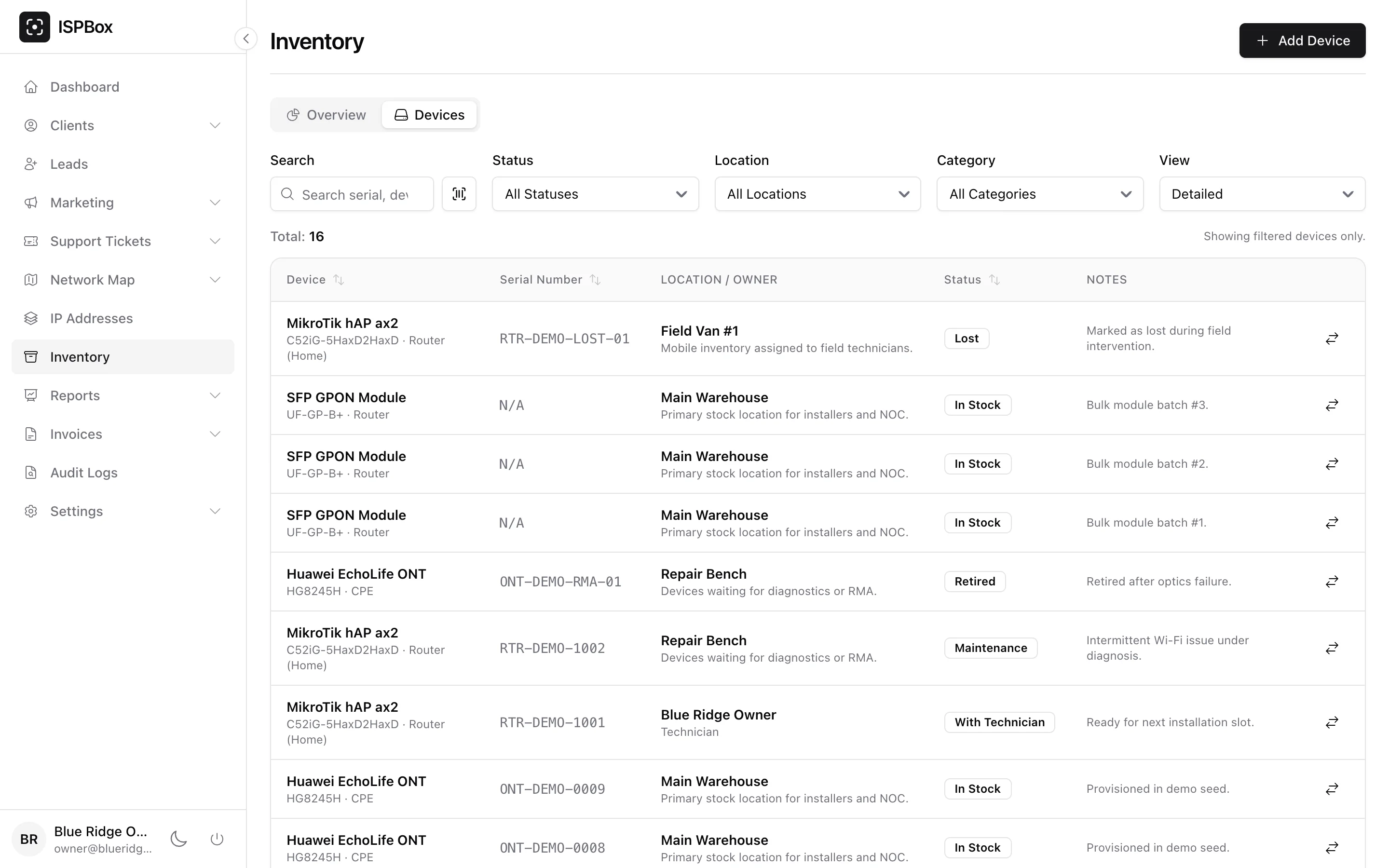
| Devices | Search and filter every device unit; open device management |
Overview Tab
Status Summary
Shows counts of devices by status (for example: In Stock, With Technician, Installed, Maintenance, Retired, Lost). Use this to spot shortages, missing devices, or operational issues quickly.
Locations Overview
Use locations to represent real storage spots.
- Add a new location with the
+button. - Edit a location name/description.
- Delete is blocked if the location still has devices assigned.
Equipment Templates
Templates define what you stock (not individual units).
- Create templates for each hardware type you keep (for example "Router X", "ONU Model Y").
- Set requires serial number on templates whose units you track individually (routers, ONTs, radios) and leave it off for anything you count in bulk (patch cords, SFPs, brackets).
- Edit template details at any time.
- Delete is blocked if the template already has devices (units) created.
Categories
Categories keep templates organized.
- You can create and edit your own categories.
- System categories cannot be deleted.
- A category cannot be deleted if it still has templates assigned.
Devices Tab
Filters (Find What You Need Fast)
| Filter | What it matches |
|---|---|
| Search | Serial number, device/template name, model, client name (via installed service), technician name, location name |
| Status | In Stock / With Technician / Installed / Maintenance / Retired / Lost |
| Location | Only devices currently stored at a location |
| Category | Devices whose template belongs to the selected category |
| View | Detailed (per device) or Grouped by Item (summary counts) |
The small icon next to the search box opens your device camera and scans a barcode or QR code straight into the search field - the fastest way to answer "where is this box supposed to be?" while standing in the warehouse.
View Modes
| Mode | Best for |
|---|---|
| Detailed | Finding a specific device (serial, notes, who has it, what service it is on) |
| Grouped by Item | Quick stock counts by device type and current holder/location |
Detailed List Columns (What You Are Seeing)
| Column | Meaning |
|---|---|
| Device | Template name + model + category |
| Serial Number | Serial (or N/A if not used for that template) |
| Location / Owner | One of: installed service (service ID + client), technician, or inventory location |
| Status | Current device status |
| Notes | Short notes recorded on the unit |
| Action | Opens device management for that unit |
Receiving / Adding Devices (Button: "Add Device")
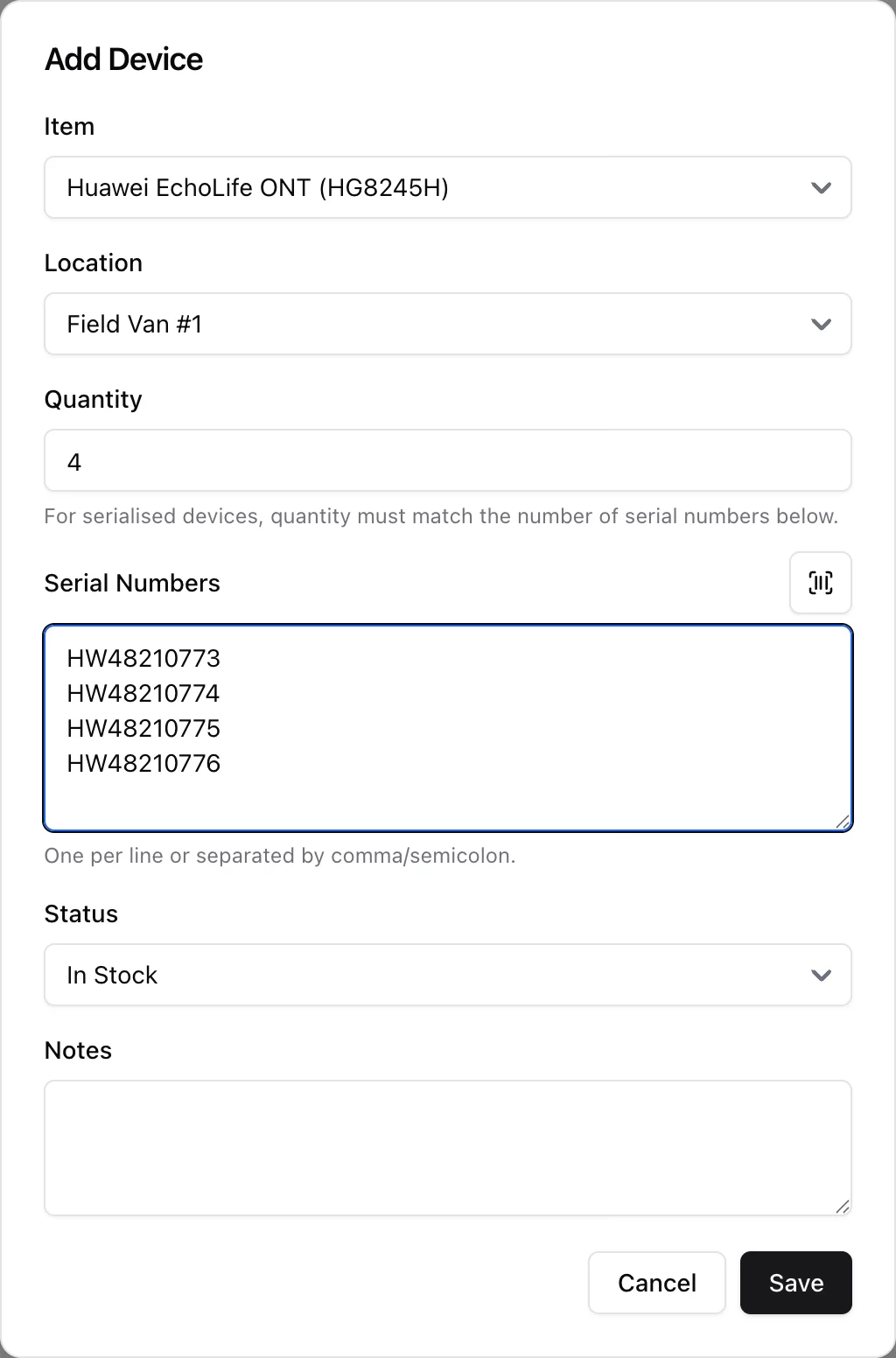
When you click Add Device, you are creating one or more device units under a template.
| Field | What it does |
|---|---|
| Item | Select the equipment template (required) |
| Location | Where the device is stored (required for In Stock) |
| Quantity | How many units to add, up to 50 per batch. For serialized templates it must match the number of serial numbers you enter |
| Serial Numbers | One per line, or separated by commas/semicolons. Required if the template requires serial numbers |
| Status | Allowed when receiving: In Stock / Maintenance / Retired / Lost |
| Notes | Optional note stored on the device unit |
Receiving a whole box at once
Serialized hardware does not have to be entered unit by unit. Set the quantity, then paste or scan the serials into the Serial Numbers box - the scan button next to it keeps the camera open and appends each code on its own line, so you can walk down a pallet scanning labels. On save, ISPBox creates one device per serial in the chosen location.
Validation rules to expect:
- Up to 50 serial numbers in one batch.
- Quantity must match the number of serials provided - a mismatch names both counts so you can see which is wrong.
- Duplicates are rejected, both within your input and against serials that already exist in your inventory. The error lists the offending serials.
- "In Stock" devices must have a Location.
- Non-serialized templates just take a quantity and create that many units.
Device Management (/inventory/unit/{unit})
What You Can Do Here
This page is for managing a single physical device:
- attach/detach it to a service (installed vs returned),
- assign it to a technician or move it to a location,
- update the serial number,
- mark it as Maintenance, Lost, or Retired,
- review the full Activity History.
Device Information (Core Controls)
| Field | What it is for |
|---|---|
| Service | Shows the installed service (if any). Use Assign to attach, or Detach to return the device from service. |
| Technician | Assigns the device to a specific person (device becomes "With Technician"). |
| Location | Stores the device in inventory (device becomes "In Stock"). |
| Serial Number | Update/record the serial (must remain unique). |
| Status | Readable status label; some statuses are set via actions (maintenance/lost/retire). |
| Received/Installed/Retired timestamps | Helps auditing lifecycle events. |
How ownership works (practical rule):
- A device is tracked in one place at a time: either at a location, with a technician, or installed on a service. Assigning to one clears the others.
Notes (Applied To Changes)
The Notes box on this page is an optional comment that will be recorded alongside the actions you take (useful for "why" and handoffs).
Activity History (Audit Trail)
Shows the last actions for the device:
- when it happened,
- what action was performed,
- from and to (location/user),
- who performed it,
- and the note.
Common Workflows
1) Set up inventory from scratch
- Create Categories (optional, but recommended).
- Create at least one Location (warehouse/office).
- Create Equipment Templates.
- Use Add Device to receive devices into stock.
2) Hand a device to a technician
- Open the device from the Devices tab.
- Set Technician.
- Save changes (status becomes "With Technician").
3) Install a device on a customer service
- Open the device.
- Click Assign under Service.
- Search by service ID or client name and select the right service.
- Save (status becomes "Installed").
You can also work from the other end: the service's Assigned Equipment tab attaches units to that service and is where the customer's Wi-Fi and CPE credentials live.
4) Return a device from a service back into inventory
- Open the device.
- Select the Location you want it stored in.
- Click Detach under Service (device returns to stock at that location).
5) Maintenance / Lost / Retire
- Use the top-right menu to mark the device.
- Use Retire when the device should no longer be used (confirmation required).