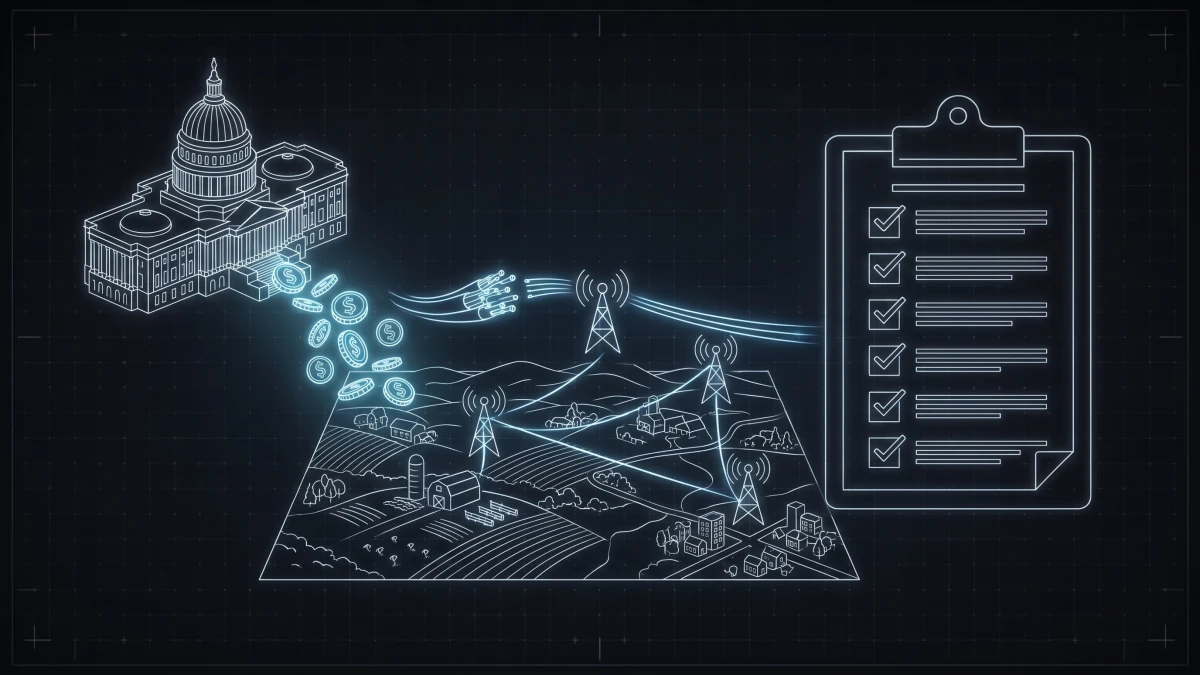
The Broadband Equity, Access, and Deployment program - BEAD - is $42.45 billion of federal money for building broadband to unserved and underserved locations, distributed through the states. For a small ISP, that sentence contains both the opportunity and the warning: the money is real and it is being awarded right now, but it arrives wrapped in state-level processes and compliance obligations that were designed with bigger companies in mind.
This guide is for the operator asking the practical questions: am I eligible, is it worth the paperwork, and what do I need to have in place to survive an award? (General "should I start an ISP" questions live in our companion playbook.)
Where BEAD actually stands in 2026
BEAD has moved from planning to awarding. After the 2025 program restructuring, states re-ran their selection processes under the "Benefit of the Bargain" framework - shifting to a more technology-neutral posture in which fixed wireless (including unlicensed-spectrum deployments) and satellite compete alongside fiber on cost, rather than fiber winning by default. Many states have completed those rounds and are pushing awards toward NTIA approval; others are still finalizing. Practical consequences:
- Timing is state-specific. Your state broadband office's website - not national coverage - is your source of truth. Some states are done selecting; late movers still have windows.
- Fixed wireless is genuinely in the game. The restructuring materially improved WISPs' position: cost-per-location now matters more, and that is small operators' natural advantage.
- Subgrantee obligations survived the restructuring. Letter-of-credit-style financial requirements (with some flexibility added), build deadlines, low-cost plan offerings, and years of reporting all remain.
Are you actually eligible?
BEAD funds go to unserved (under 25/3 Mbps) and underserved (under 100/20 Mbps) locations as shown on the FCC's National Broadband Map. Three practical checks before you invest in an application:
- Look up your target area on the FCC map. If the locations you want to build are already claimed as served at 100/20, they are not BEAD-eligible - and if a competitor overclaims coverage there, the challenge process (largely concluded in most states) determined what stuck. Know what your map reality is.
- Check your own filings. Your BDC submissions define your existing footprint. Sloppy overclaiming can remove locations from eligibility - including ones you wanted funded.
- Match the project to your scale. States award by project areas. A 500-subscriber WISP should be looking at fill-in areas adjacent to its towers, not county-wide builds - and partnering or subcontracting with a larger awardee is a legitimate path to the money without prime-awardee obligations.
What winning actually requires
Talk to operators who have been through state programs and the same themes repeat:
Money before the money. BEAD is largely reimbursement-based with match requirements (typically 25%, with state variations and waivers). You front costs, then claim them back. Between the match, the financial-capability requirements, and reimbursement lag, you need working capital or a lender who understands the program.
A defensible cost model. Under Benefit of the Bargain, you win by credibly showing cost-per-location - equipment, construction, backhaul, operations - lower than the fiber overbuilder's. Your asset here is that you already operate in the area: real tower costs, real take rates, real churn numbers beat consultants' spreadsheets.
Compliance capacity. An award brings build milestones, environmental and permitting steps, prevailing-wage considerations, the required low-cost service option, cybersecurity and supply-chain attestations, and years of subscriber and performance reporting. This is survivable for a small operator - but not with the business run on spreadsheets.
The infrastructure question nobody budgets for
Here is the part relevant to us as an ISP-software vendor, stated plainly: every BEAD obligation that outlives construction is a data obligation. Which funded locations have service, at what speeds, at what price, with which low-cost plan uptake, with what uptime - reported per program requirements, for years.
Operators who track subscribers, plans, and service addresses in one system generate these reports; operators with spreadsheet sprawl reconstruct them quarterly by hand, forever. In ISPbox, the raw material is already structured: every service is tied to a location and a plan with speed tiers, billing knows exactly who is on the low-cost offering, service records show provisioning history, and the OSS/BSS layer exports what auditors ask for. Add network monitoring for the performance side and the compliance story becomes a query, not a quarter-end project.
If BEAD is in your plans - even as a subcontractor - getting your operational data into a real system before the award is the cheapest compliance decision you will make. (It also, not coincidentally, makes the FCC BDC filings and broadband label obligations you already have easier.)
Should a small ISP bother?
An honest decision framework:
- Yes, pursue it if eligible unserved/underserved locations sit adjacent to your existing network, you can fund the match and float reimbursements, and the award size justifies weeks of application work.
- Pursue it sideways - as a partner, subcontractor, or open-access tenant - if the prime-awardee obligations are too heavy but the construction is happening in your backyard regardless.
- Skip it without guilt if your growth areas are already served on the map or your balance sheet cannot carry reimbursement lag. Plenty of excellent ISPs are being built in 2026 with no federal money and no compliance tail - the ordinary economics still work.
FAQ
What is BEAD funding? A $42.45 billion federal program funding broadband deployment to unserved (under 25/3 Mbps) and underserved (under 100/20 Mbps) locations, administered by state broadband offices that award subgrants to ISPs and other providers.
Can WISPs and fixed wireless get BEAD money? Yes. The 2025 "Benefit of the Bargain" restructuring made BEAD technology-neutral, with awards driven by cost-per-location - which materially improved fixed wireless operators' competitiveness against fiber-only proposals.
Does BEAD require matching funds? Generally yes - typically a 25% match, with state variations and waiver possibilities, and the program is largely reimbursement-based. Small applicants need working capital to front costs before claims are paid.
What reporting does a BEAD award require? Build milestones during construction, then ongoing reporting on served locations, speeds, pricing, and the required low-cost plan - for years after the build. Operators need subscriber and service data organized well enough to produce these reports on demand.