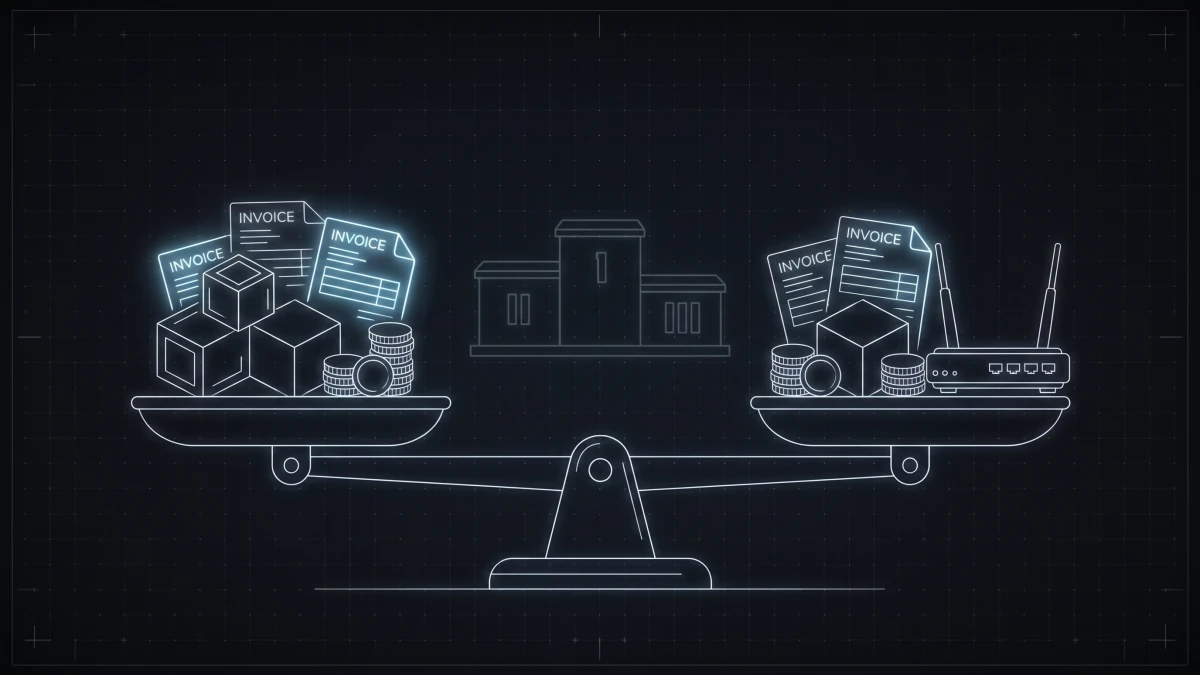
Full disclosure up front: this comparison is written by the team behind ISPbox, one of the products on the list. We think a vendor can still write a useful roundup - if the criteria are ones you can verify yourself and the competitors' strengths are stated honestly. Judge for yourself below.
ISP billing software is a decision you make once every five to ten years, usually under pressure, and the cost of choosing wrong is measured in migration weekends. Here is the field in 2026, and how to think about it.
What actually separates these products
Every vendor's homepage says "billing, CRM, provisioning." The real differences hide in five questions:
- What does entry actually cost? Published price vs "book a demo," minimums, per-subscriber metering, paid add-on modules, implementation fees.
- Does billing drive the network? The defining feature of ISP billing: an unpaid invoice should suspend service automatically - RADIUS, MikroTik, CoA - and payment should restore it, with no human in the loop.
- How deep is the billing engine? Proration, taxes, late fees with grace periods, multiple gateways with saved cards, dunning, prepaid and seasonal patterns.
- What is the migration cost? Importers with dry-run previews vs CSV archaeology vs a paid services engagement.
- Who is it built for? Enterprise telcos and small WISPs have different budgets and different tolerance for implementation programs.
The contenders
Sonar - the enterprise benchmark
Sonar is a mature, capable platform and the reference point for larger North American ISPs. Deep billing, strong workflows, serious API. The trade-off is equally clear: enterprise pricing (per-subscriber with a monthly minimum in the hundreds of dollars) and a guided implementation program to get live. If you have thousands of subscribers and a back-office team, Sonar belongs on your shortlist. If you have 300 subscribers, its minimums are your entire software budget. Our detailed comparison.
Splynx - powerful, modular, priced accordingly
Splynx is the established name in the WISP mid-market: broad functionality, RADIUS depth, lots of configurability. Its model is a licensed core plus paid add-on modules - maps, monitoring, inventory and friends are separate line items - with an entry license sized for 400 subscribers regardless of whether you have 40. Powerful if you need its full breadth and have an admin who enjoys configuration; the total cost compounds as modules stack up. Comparison and migration guide.
Powercode, VISP, BillMax and the legacy tier
These platforms have billed ISPs for decades and still run plenty of networks. The shared pattern: proven core billing, aging interfaces, desktop-era architectures, and modernization that arrives slowly. Operators on them rarely praise them - they stay because migration is scary, which is a real cost of choosing them today: eventually you leave, and later is more expensive than sooner. We maintain comparisons for Powercode, VISP and BillMax.
UISP CRM - free, and priced accordingly
Ubiquiti's UISP includes a free CRM with basic invoicing, which makes it the default first system for Ubiquiti-based WISPs. Its limits are structural: billing depth stops at basic recurring invoices, support tooling is minimal, and the platform is built around one hardware vendor. We wrote a full analysis in UNMS is now UISP: what changed - the short version is that UISP is an excellent network tool whose CRM most growing operators eventually outgrow. Comparison.
ISPbox - where we obviously think you should look
What we built, and why it is on this list: transparent plans from $25/month with the whole platform included - no add-on modules, no per-subscriber metering, no implementation program. Billing drives the network natively: unpaid invoices suspend via RADIUS/MikroTik provisioning and restore on payment, live via CoA. The engine covers proration, taxes, late fees, four payment gateways with saved cards and autopay, prepaid periods and seasonal suspensions. Around it: customer portal, ticketing with email-to-ticket, network map and monitoring, IPAM, inventory, native mobile apps for technicians and subscribers, a REST API, and an AI assistant your staff can talk to via Claude or ChatGPT.
Migration is the part we are proudest of: importers for Sonar, Splynx, UISP, Powercode and QuickBooks with dry-run preview and rollback - you see exactly what will be created before anything goes live.
The honest limits: ISPbox is built for small and mid-size operators, not tier-1 telcos; if you need carrier-grade OSS integrations or thousand-seat call-center tooling, the enterprise tier is where you should shop.
The bottom line
- Thousands of subscribers, enterprise budget: Sonar.
- Need maximum configurability and accept modular pricing: Splynx.
- Ubiquiti-only network, simple billing, no budget: UISP CRM - until you outgrow it.
- Small-to-mid ISP that wants the full stack at a published price: ISPbox, $25/month, 7-day trial, importer included. See how it compares to whatever you run today on our alternatives pages.
FAQ
What does ISP billing software cost in 2026? The spread is wide: free (UISP CRM) through $25-250/month published plans (ISPbox) to $255+/month licenses plus modules (Splynx) and $500+/month enterprise minimums plus implementation (Sonar).
What is the most important feature in ISP billing software? Billing-driven provisioning: unpaid invoices automatically suspending service at the RADIUS/router level and restoring on payment. Without it you are running two systems glued together with scripts.
Can I migrate between ISP billing platforms without losing data? Yes, if the destination has real importers. Look for dry-run previews and rollback - the difference between a controlled cutover and a weekend of CSV surgery.
Is free ISP billing software good enough? UISP CRM works for small, Ubiquiti-based networks with simple monthly billing. Proration, taxes, dunning, gateway autopay and multi-vendor provisioning are typically where free options run out.