Delinquent Enforcement (Dunning)
ISPBox's automatic collections: reminders, then blocking or throttling overdue services after the grace period, billing-while-blocked options, instant restore on payment, and temporary overrides.
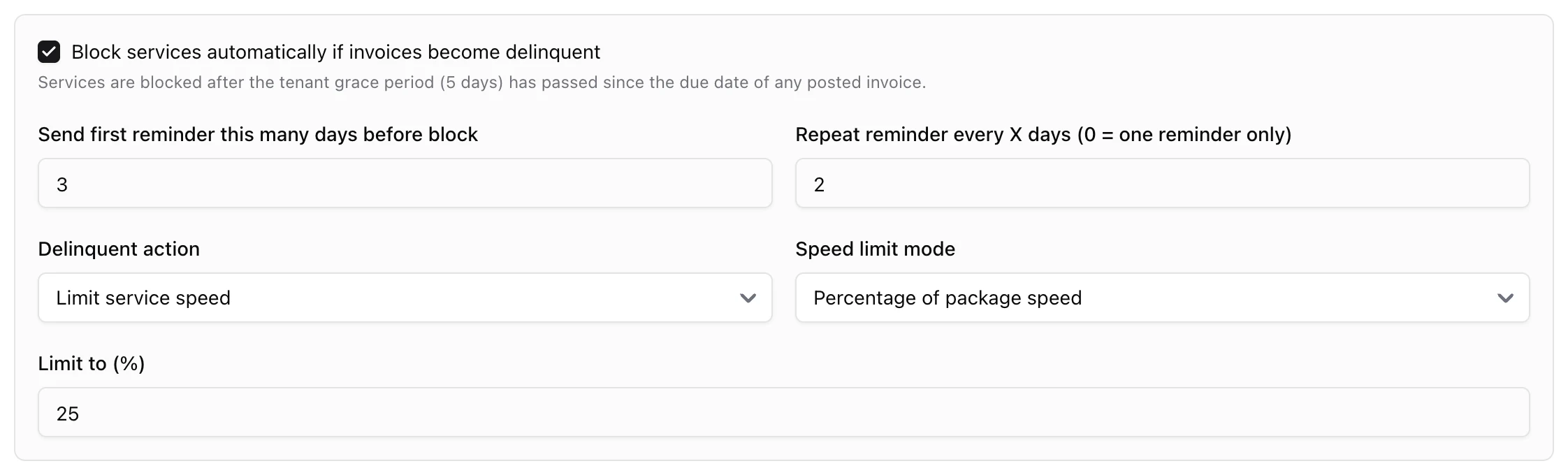
Dunning is ISPBox's automatic collections engine. Once switched on, it watches for overdue invoices, sends payment reminders, and then either blocks or throttles the customer's service until they pay - and restores it the moment they do. It runs on its own every hour; you only configure the rules.
1. Turn it on
Go to Settings > Invoices > Automation and enable Block services automatically if invoices become delinquent. The help text confirms the rule: services are enforced after your grace period has passed since the due date of any posted invoice.
2. The timeline
Three dates drive everything, all derived from an invoice:
- Due date = the bill date plus your payment terms.
- Enforcement date = the due date plus your Grace period (set on the Billing cycle tab). This is when a service is blocked or limited.
- Reminders begin "Send first reminder this many days before block" and then repeat every "Repeat reminder every X days" (set it to 0 for a single reminder).
So with a 5-day grace and a 3-day reminder lead, a customer whose invoice falls due on the 1st gets a first reminder on the 3rd and is enforced on the 6th if still unpaid.
3. Block or throttle
The Delinquent action decides what happens at enforcement:
- Block access completely - the service is removed from the network (RADIUS/router access pulled). The customer is offline until they pay.
- Limit service speed - the customer stays connected but slow. Pick a Speed limit mode: a percentage of the package speed, or a static speed in Mbps. A throttle is often gentler on support load than a hard cut - the customer can still reach your portal to pay.
4. Billing while a service is blocked
Right below the action is Billing while blocked for non-payment, which decides whether invoices keep accruing during a block:
- Keep billing - invoices are issued while blocked (the debt keeps growing).
- Pause - invoice the missed period after unblocking - no invoices during the block, but the missed period is billed once they return.
- Pause - the blocked period is never invoiced - the blocked stretch is written off.
Speed-limited services always keep billing - the pause options apply to full blocks only.
5. Restoring service
You do not unblock delinquents by hand. When a payment settles the overdue invoices, the service is restored immediately - it does not wait for the next hourly run - and it returns to its prior status. The hourly job also unblocks anyone who is no longer delinquent for any other reason.
6. Giving someone more time (temporary override)
Need to keep a customer online despite an overdue invoice - a payment promise, a dispute, a goodwill gesture? Unblock them with a temporary override: a duration in hours (up to 720, i.e. 30 days) and a reason. Dunning will skip that client until the override expires, then resume normal enforcement automatically. The reason is recorded for the audit trail.
7. How it interacts with FUP
Delinquency always outranks fair-use throttling. While a service is under delinquency enforcement, FUP data caps will not touch its connection - the dunning engine owns the network state until the customer pays.