Changing a Client's Plan
Upgrade, downgrade or fix a plan mid-period with fair automatic settlement - settle now or on the next invoice, or schedule the change for renewal.
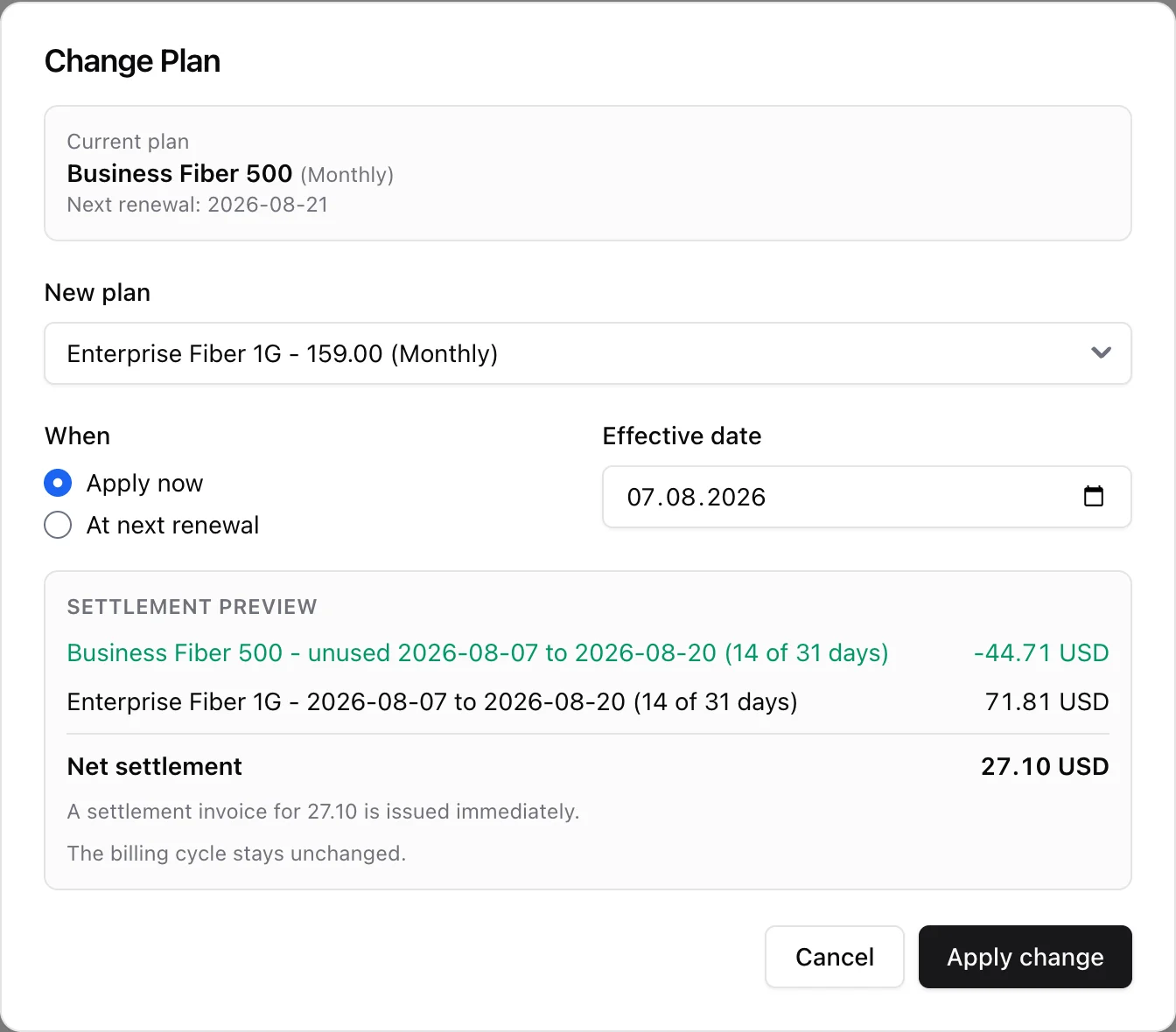
Customers change their minds mid-contract - they upgrade for a home office, downgrade to save money, or you simply put them on the wrong plan at signup. ISPBox handles all of it from one place with fair, automatic mid-period settlement: the customer is credited for the unused time of the old plan and charged a prorated amount for the new one, day-accurate, with the math shown to you before you confirm.
1. Where to change a plan
Open the client, switch to the Billing tab and click Change plan on the service. You pick the new plan, choose when it takes effect - Apply now (today or backdated within the billed period) or At next renewal - and ISPBox shows a settlement preview with the exact credit, charge and net amount before anything is applied.
Changing the package on the service edit page goes through the same engine: instead of silently swapping, ISPBox shows the settlement and asks you to confirm - or to swap without billing when you are just correcting a data entry mistake (see below).
2. How the settlement is calculated
- The credit refunds the unused remainder of what was actually invoiced - so price overrides and prorated first cycles credit exactly what the customer paid for, never the list price.
- The charge bills the new plan for the same remaining days, prorated against a full billing interval - exactly how the engine would have billed those days.
- Both lines share the same day counts, so the invoice reads as one coherent story, and the settlement invoice PDF carries a plain-language explanation of the change for the customer.
- A second change in the same period settles against the previous change's charge - the same days are never credited twice, and the credit carries the tax rate the charge was actually invoiced with.
3. Settle now, or on the next invoice
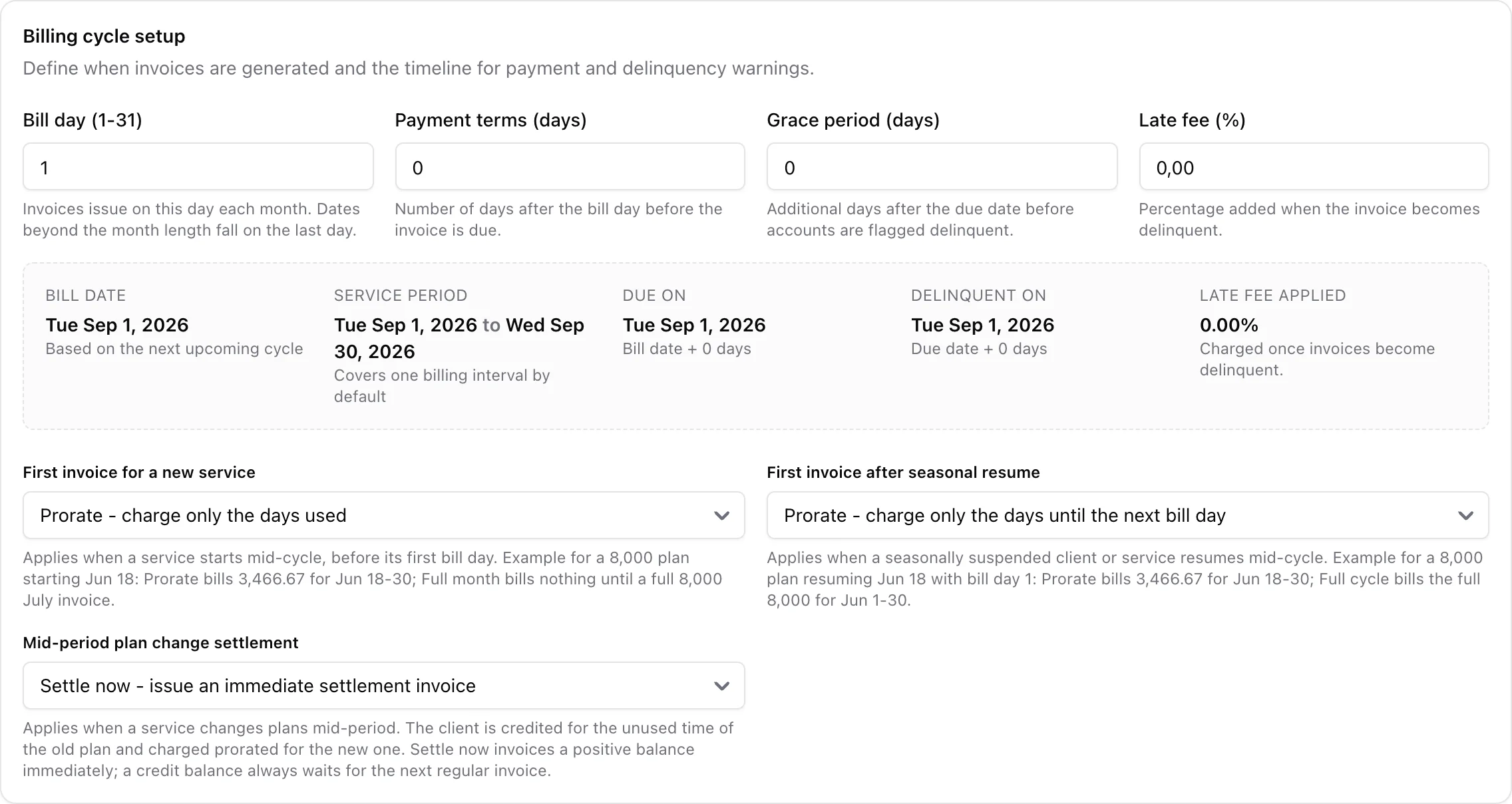
Under Settings > Invoices > Billing cycle you choose what happens with the settlement money:
- Settle now - a positive balance (upgrades) becomes an immediate settlement invoice, emailed like any other invoice per your automation settings.
- Next invoice - the credit and charge wait as pending lines and are merged into the next regular invoice.
Two rules hold in both modes: a credit balance never becomes an invoice - it always waits for the next regular invoice - and an invoice never goes negative. If a credit is larger than the next invoice's charges, the invoice is reduced to zero and the remainder automatically carries over to the following one.
4. Scheduling a change for later

Choose At next renewal and the change is stored, listed in the Plan changes card on the billing tab (with a Cancel button), and applied automatically in the early morning of its effective date - before that day's invoices are generated, so a renewal-day change simply bills the new plan from day one. The card also keeps the history of applied changes with their settlement amounts.
5. Switching between billing periods
A move between plans with different billing periods - say monthly to yearly - has no meaningful mid-period math, so ISPBox applies it at the renewal date: the picker steers you to scheduling, and on renewal day the invoice simply bills the new plan and cycle. If the renewal-day invoice already went out with the old plan, ISPBox recovers cleanly: the old charge is credited in full, the new plan is billed for its own cycle, and the billing calendar moves to the new interval - all visible on the settlement invoice.
6. Fixing mistakes without billing anyone
Sometimes the plan on file is simply wrong - a typo at signup, an import mismatch. When you change the package on the service edit page, you can choose swap without a settlement: the service moves to the correct plan and is reprovisioned, but no credit or charge is created. The change is still recorded in the history and audit log.
7. What else happens on a change
- The service is reprovisioned to the new speeds on RADIUS / MikroTik immediately; if the network sync hiccups, the change stays billed and the sync retries automatically in the background.
- An active FUP throttle is lifted when the new plan has no data cap, and preserved when it has one.
- Changes are refused while the service is blocked for non-payment, seasonally suspended or the client is blocked - same guardrails as the customer portal.
- Every change lands in the audit log with who, when and the settlement amounts.